


Horizontal Drilling Technology
Press Drilling (Uncontrolled)
Press drilling is the cost-effective, basic technology in which pipes are pressed into the ground without causing vibrations using a hydraulic system. It is used in sewer construction or when crossing under roads, rail tracks, and other Infrastructure. Press drilling is suitable for various pipe materials and can be performed in almost all soil types, including Rock. Applications include pressure sewer lines, water mains, pipelines, district heating lines, gas lines, cables, and more. Interestingly, this method can also be used without a receiving pit when applied in compressible soils.
Advantages of press drilling:
- Minimal surface disruption: The method is particularly well-suited for urban areas with limited space.
- Cost-effective process: Precision comparable to pipe jacking, but generally more cost-effective due to efficient equipment technology.
Application Criteria
Horizontal Directional Drilling Method, Section 6.1.2.2.2
200 - 1000 mm
10–30 m (in exceptional cases)
Steel, stoneware, reinforced concrete, concrete, polymer concrete, cast metal, PVC, KG, PE-HD, fiberglass-reinforced plastic
For unguided drilling, the precise setup of the machine is particularly important. The following principle applies: The longer the drill pit, the more accurate the borehole will be, since longer pipe sections can be used.
With this system, obstacles made of steel or reinforced concrete can only be removed by taking additional measures.
in almost all types of soil and in rock up to DN 400, even in hard rock (soil classes LN, LB, S1-3, FZ 1-4, FD 1-4)
Pressurized sewer lines, water mains, pipelines, district heating lines, gas lines, cables, and much more.
Crossing rivers, roads, highways, railroad tracks, buildings, and much more.
Procedure Description
This procedure is carried out in two phases as follows:
Phase 1: Driving the Steel Casing Pipes
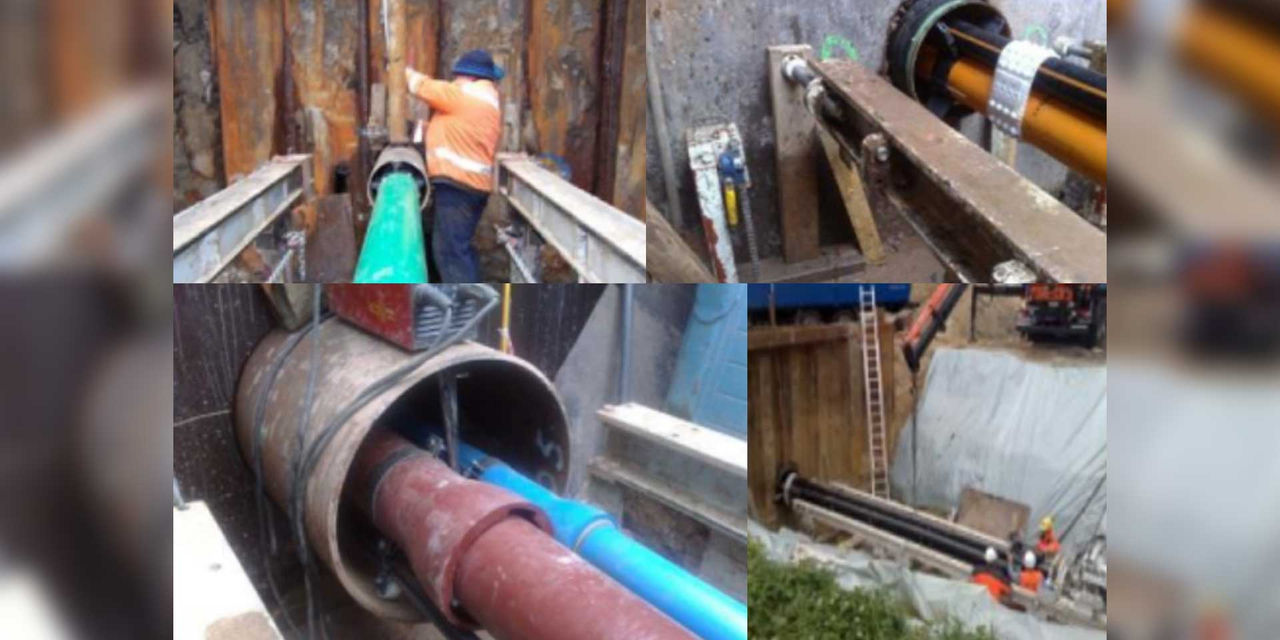
The jacking rig is installed in a launch pit at the specified slope. The steel jacking pipe is hydraulically driven into the ground, while the drill head is simultaneously driven forward by the augers. The rotational movement of the augers conveys the excavated soil into the launch pit. The resulting thrust forces are transferred to the surrounding soil via the abutment.
Rock: By using a pneumatic down-the-hole hammer, we can carry out the execution of work for drilling holes up to DN 400 even in hard rock.
Unstable soils and groundwater: In unstable soils, the drill head is run set back inside the steel pipe. This effectively prevents the formation of voids. When drilling in groundwater, this technique can also be used to create the borehole. However, if the water table is more than 0.50 m above the top of the pipe or if flowing soil types are encountered, it is better to use a pilot pipe installation with a groundwater auger.
Special feature: This method can be performed without a landing pit. When drilling in displaceable soils, a landing pit is not required.
Phase 2: Installation of the service pipes
The jacking rig is installed in a launch pit at the specified slope. The steel jacking pipe is driven hydraulically into the ground, while the drill head is simultaneously driven by the augers. The rotational movement of the augers conveys the soil into the jacking pit. The resulting jacking forces are transferred into the surrounding soil via the abutment.
Rock: By using a pneumatic down-the-hole hammer, we can carry out the execution of work for drilling holes up to DN 400 even in hard rock.
Unstable soils and groundwater: In unstable soils, the drill head is run recessed within the steel pipe. This effectively prevents the formation of voids. When drilling in groundwater, this technique can also be used to create the borehole. However, if the water table is more than 0.50 m above the top of the pipe or if flowing soil types are present, it is better to use pilot pipe installation with a groundwater auger.
Special feature: This method can be used without a landing pit. When drilling in displacable soils, a landing pit is not required.
Current
News
Information and updates from the various business divisions of the Max Bögl Group. Read the latest articles about our services, Technologies, and what we’re doing.


