Social Share Icon

Horizontal Drilling Technology
Pilot Pipe Trenching

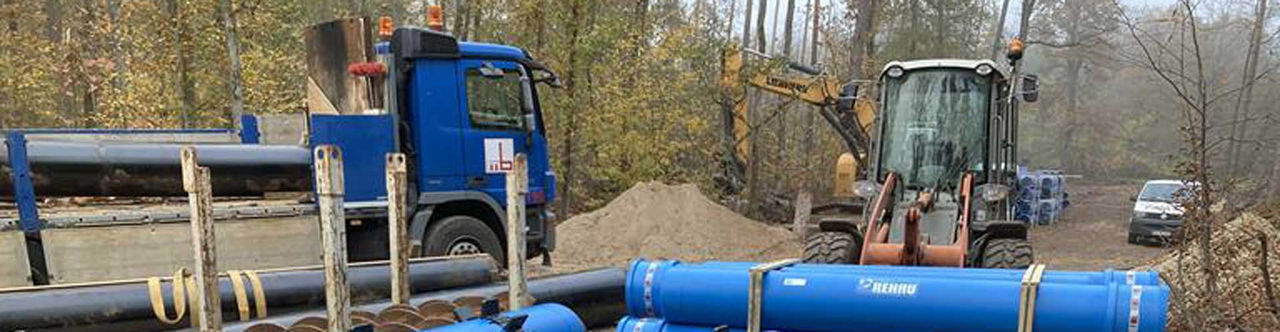
Pilot pipe driving is a civil engineering method in which a pilot pipe string is first driven in a controlled manner, either displacing or extracting soil. Surveying is performed using a theodolite equipped with an electronic camera. Changes in direction are achieved via the control surface at the pilot pipe tip, utilizing the reaction force of the soil. Subsequently, casing or product pipes with the same or larger outer diameters are installed while simultaneously pressing or pulling out the pilot pipes. This method enables the precise construction of pipeline tunnels.
    Advantages of pilot pipe boring:

    • Precise installation: Pilot pipe drilling allows for the precise placement of pipes and lines.
    • Minimal surface disruption: This method is particularly well-suited for urban areas with limited space.
    • Cost-effective process: It offers precision comparable to pipe jacking but is usually more cost-effective due to the efficient equipment technology.

    Application Criteria

    Pilot Pipe Trenching, Section 6.1.3.2

    150–600 m with a tunnel boring pipe, 100–900 m with a steel casing

    75 m with a tunnel-boring pipe, 95 m with a steel casing

    Sewer tunneling pipes: vitrified clay, reinforced concrete, polymer concrete, PP, FRP; Steel protective casings: steel, vitrified clay, reinforced concrete, concrete, polymer concrete, cast iron, PVC, PE-HD-FRP, composite thermal insulation pipes

    0.1% of the drill length

    In displaceable loose rock of classes LNE1 through LNE2, LNW1 through LNW2, and LBM1 through LBM3 according to DIN 18319, with impact values up to approximately N10 (DPH) = 30. Stones with grain sizes up to 80 mm that are sporadically embedded in the subsoil can either be displaced or removed during reaming.

    Sewer Trenchless Pipe: Precision trenchless installation of gravity sewers Steel casing: Precision trenchless installation of steel casings for sewers, pressurized wastewater lines, water mains, gas lines, heating pipes, cable conduits, and drainage systems

    Crossing rivers, roads, highways, rail lines, buildings, open spaces, and natural habitats. Longitudinal installation in narrow sections, at great depths, and where there are many existing utility lines, as well as, of course, for service connections to homes

    Process Description (Steel Casing)

    This process is carried out in three phases as follows:

    Gesteuerte Pilotbohrung

    Phase 1: Guided Pilot Drilling

    The execution of steered pilot pipe drilling in soil suitable for displacement involves the use of pilot pipes (outer diameter 114 mm) equipped with an optical sight, a steering head, a theodolite with a CCD camera, and a monitor. The pilot pipe is pressed through the soil into the target pit, while direction and inclination are monitored. The beveled surface of the steering head allows the bore to be steered in all directions, thereby preventing deviations from the planned bore path.

    Phase 2: Expansion Drilling

    1. The pilot string and the steel pipe are connected to each other using an expansion stage (active or passive).
    2. The press pipe is hydraulically pre-pressed, while at the same time the Soil being pushed into the press pipe is drilled out by the augers.
    3. The pilot string guides the steel pipe in the precisely specified direction.
    4. During the reaming process, the pilot string advances into the target pit, where it is unscrewed and dismantled.


    In loose to moderately dense sand and gravel soils, a passive reaming stage is used. In this case, the drill head runs set back within the protection of the steel pipe. In dense soil conditions, it is no longer possible to press the ribs of the passive reaming stage into the soil. An active expansion stage is therefore used, in which a cutting disc runs immediately in front of the steel pipe. The openings in the cutting disc can be reduced depending on the expected rock diameter, thereby minimizing the risk of ground collapse. When tunneling in groundwater, so-called “groundwater locks” are used.

    Gesteuerte Pilotbohrung
    Gesteuerte Pilotbohrung

    Phase 3: Feeding the sewer tunneling pipes

    Installation of one or more utility pipes as a bundle into the steel protective casing on sliding skids. Upon customer request, we can also backfill the annular space between the pipes.

    Current

    News

    Information and news from the various business divisions of the Max Bögl Group. Read the latest articles about our services, Technologies, and what we’re doing.

    Neuauftrag: Verlängerung U-Bahn-Linie 5-West von Laim nach Pasing

    Neuauftrag: Verlängerung U-Bahn-Linie 5-West von Laim nach Pasing

    22.12.2023

    Am 21.12.2023 hat die Landeshauptstadt München die Bietergemeinschaft Wayss & Freytag Ingenieurbau AG / Ed. Züblin AG / Max Bögl Stiftung & Co. KG mit dem Bau der Verlängerung der U-Bahn-Linie 5-West Baulos 2 von Laim nach Pasing beauftragt.

    Mehr erfahren >>
    A 3 Nürnberg – Passau sechsstreifiger Ausbau zwischen AK Regensburg und AS Rosenhof Schlüsselbauwerk: Bahnbrücke Burgweinting am 3. November fertiggestellt

    A 3 Nürnberg – Passau sechsstreifiger Ausbau zwischen AK Regensburg und AS Rosenhof Schlüsselbauwerk: Bahnbrücke Burgweinting am 3. November fertiggestellt

    07.11.2023

    Die Bahnbrücke Burgweinting, welche die BAB 3 in Regensburg-Burgweinting über 23 Gleise der Deutschen Bahn führt, ist das Schlüsselbauwerk des sechsstreifigen Ausbaus der A 3 bei Regensburg. Die Brücke ist rund 196 Meter lang und besteht aus zwei Teilbauwerken, die unter Aufrechterhaltung des Autobahn- und Eisenbahnverkehrs neu gebaut werden mussten.

    Mehr erfahren >>
    Flughafentunneldurchstich in Stuttgart

    Flughafentunneldurchstich in Stuttgart

    15.09.2023

    „Glück auf“ im Projekt Stuttgart 21: Die Deutsche Bahn hat sämtliche Tunnel des Projekts erfolgreich vorgetrieben. Insgesamt haben die Mineure rund 56 Kilometer Tunnel gegraben. Mit dem heutigen letzten Tunneldurchschlag im neuen Flughafentunnel ist ein historischer Meilenstein des Projekts Stuttgart 21 erreicht.

    Mehr erfahren >>
    Firmengruppe Max Bögl baut die neue Saalequerung Salzmünde

    Firmengruppe Max Bögl baut die neue Saalequerung Salzmünde

    01.03.2023

    In einer öffentlichen Ausschreibung mit Präqualifikation war die Firmengruppe Max Bögl erfolgreich und hat den Zuschlag für den Bau der neuen Saalequerung bei Salzmünde vom Auftraggeber, der DEGES Deutsche Einheit Fernstraßenplanungs- und -bau GmbH, erhalten.

    Mehr erfahren >>
    Erneuerung der Eisenbahnüberführung über die Donau bei Fridingen

    Erneuerung der Eisenbahnüberführung über die Donau bei Fridingen

    24.06.2024

    Auf der Eisenbahnstrecke von Tuttlingen nach Sigmaringen wurde eine Erneuerung der 130 Jahre alten Stahlfachwerkbrücke über die Donau notwendig. Für den Ersatzneubau ist die alte Brücke mit einem Gewicht von 300 Tonnen zunächst halbiert und abschließend ausgehoben bzw. abgebrochen worden. Anschließend wurden die alten Widerlager und Pfeiler abgebrochen sowie der Bahndamm ein Stück zurückgebaut, um Platz für das neue Bauwerk zu schaffen.

    Mehr erfahren >>
    Firmengruppe Max Bögl errichtet Brückenbauwerk über die Saale

    Firmengruppe Max Bögl errichtet Brückenbauwerk über die Saale

    29.05.2024

    Im Zuge der A143 Westumfahrung Halle ist eine Querung der Saale erforderlich. Mit dem Bau der imposanten Brücke wurde die Firmengruppe Max Bögl beauftragt. Das Projekt beinhaltet darüber hinaus auch die Herstellung eines Lärmschutztunnels sowie von Einschnitten mit Stützwänden.

    Mehr erfahren >>
    Tunnel for the Great Wendlingen Curve completed

    Tunnel for the Great Wendlingen Curve completed

    22.02.2024

    A final ‘Glück auf’ in Oberboihingen: the tunnel for the Große Wendlinger Kurve has been completed. Deutsche Bahn has been building this addition to the Stuttgart–Ulm rail project on behalf of the state of Baden-Württemberg since mid-2019. The miners have dug around 660 metres of tunnel. With the ceremonial breakthrough, Deutsche Bahn has reached a milestone in the expansion of the region's rail network. This is because the Kleine and Große Wendlinger Kurve will connect the existing Stuttgart–Tübingen railway line with the high-speed line being built as part of Stuttgart 21 on the Fildern plateau.

    Mehr erfahren >>